
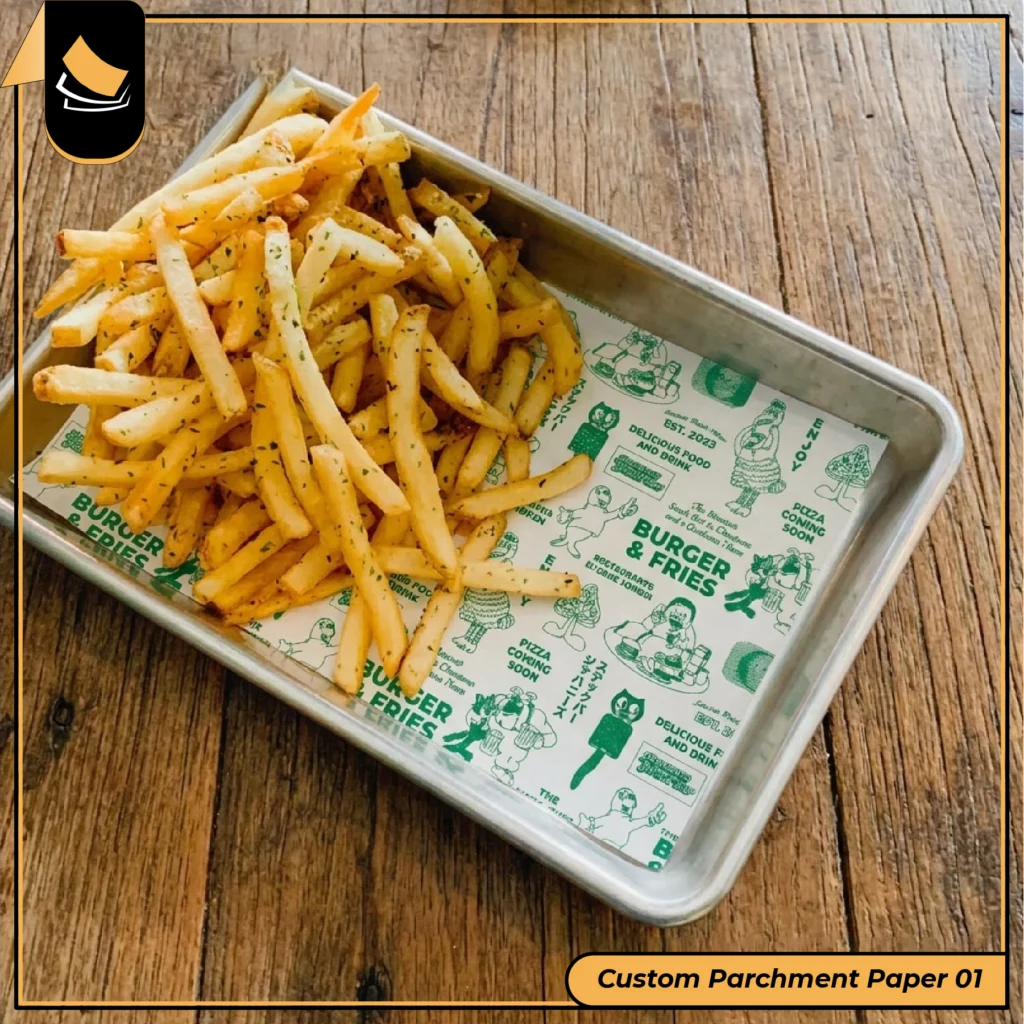
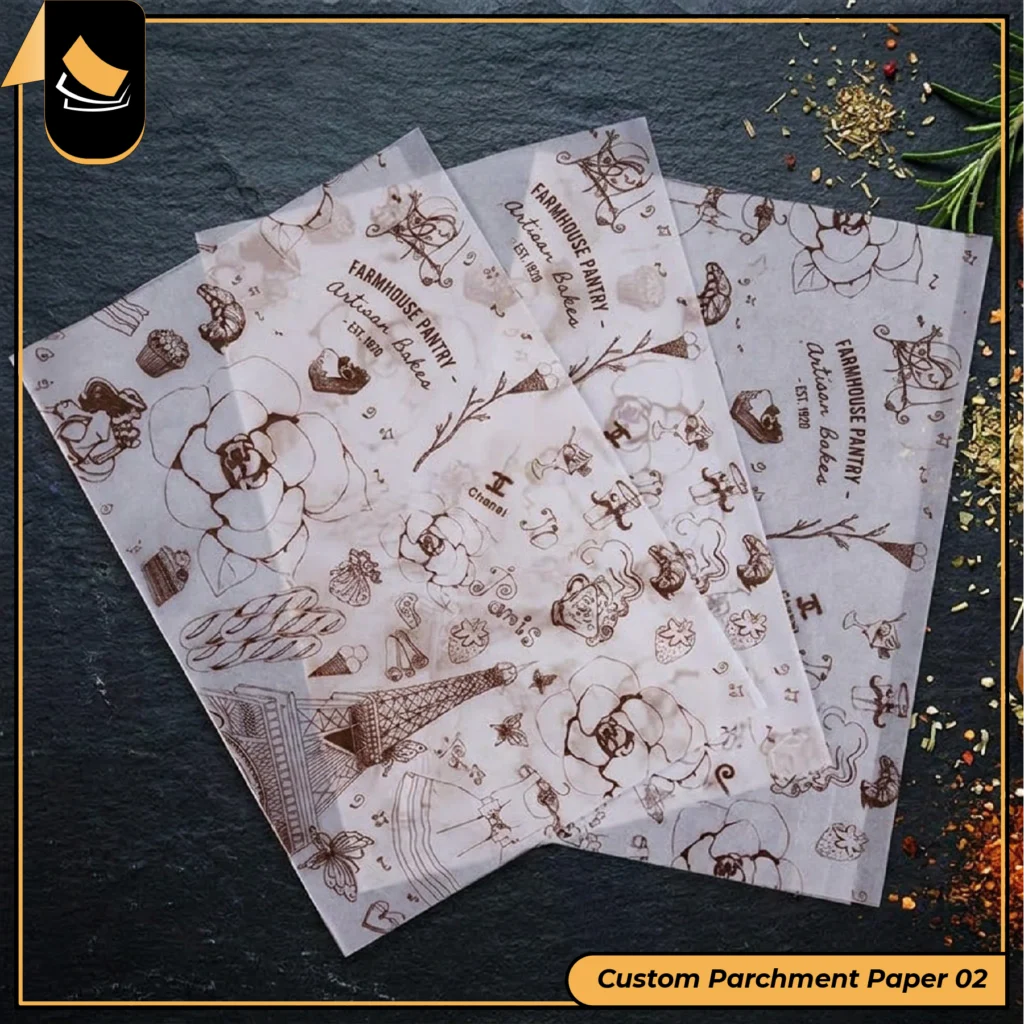
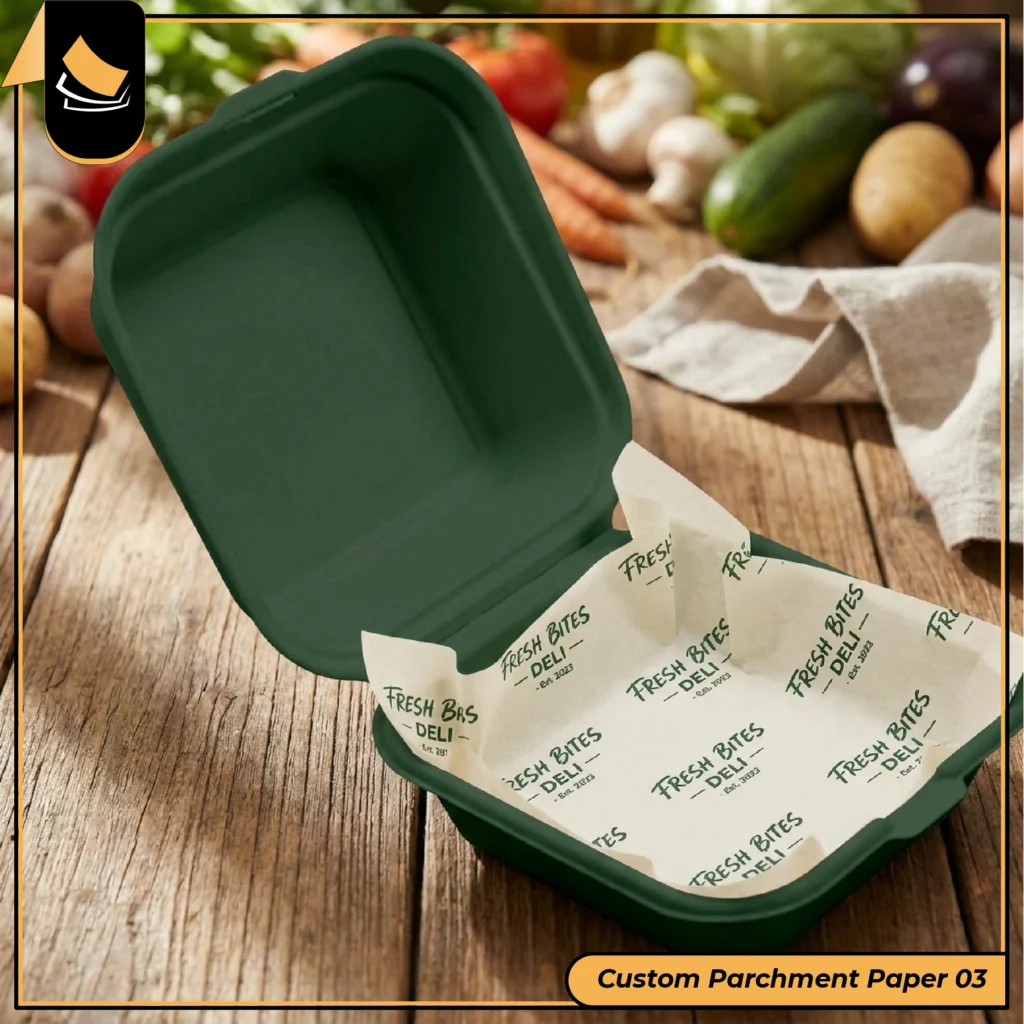
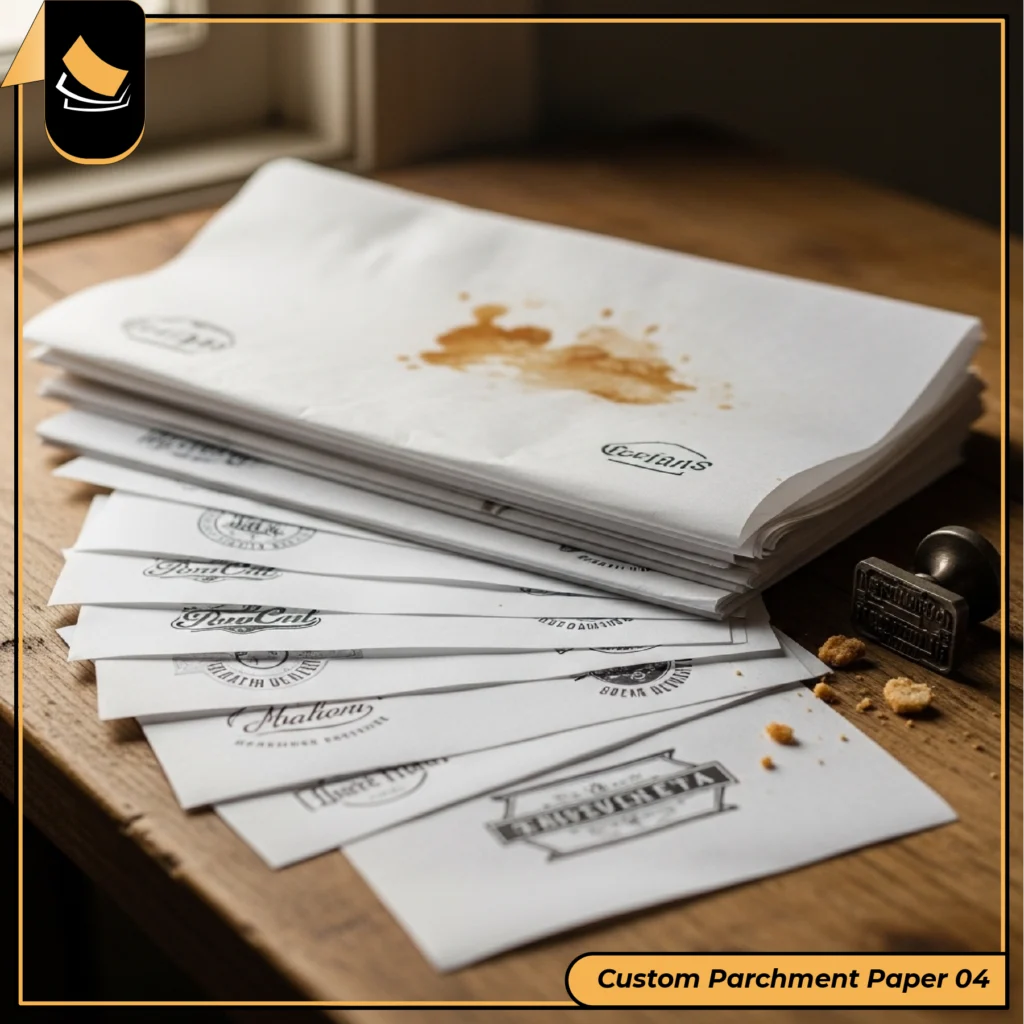
Baking businesses have to face one common problem, which is the poor presentation of their baked items. When customers see the baked items on sticky and torn paper. Your weeks of recipe testing fail in a single second. A standard baking sheet will leave you scraping away your food and turn your kitchen into a high-stress nightmare of scorched pans. With the use of custom parchment paper, you will end this baking gamble.
This paper is manufactured with food-grade, non-stick silicone coatings. This coating handles high-heat applications flawlessly. Now you do not have to scrub the pan and risk your brand’s reputation. Our parchment paper with logo protects your baked items and shows your business professionally. Customized parchment sheets are heat-resistant and non-stick in nature. They can also be used for reheating baked goods and high-grease food items. In the UK, wood fiber is treated with sulfuric acid and silicone coating to make parchment. Brands can select diverse customization options for the paper as per their branding needs and budget.
Applications and What Businesses Actually Need to Specify
Custom parchment paper rolls have multiple applications in the food industry. Brands have to understand their specific needs and choose the paper accordingly. Some of the common applications are as follows:
- Bakers and food service need a non-sticky tray lining that requires a silicone coating with thermal stability. Make sure to specify the coat weight at the time of order placement.
- Deli and butcher shops need paper with critical barrier properties and a quilon-free formulation for direct food contact.
- Pharmacies need clean and room-grade parchment for sterilization pouches, so the paper must comply with ISO 11135.
Some of the common applications of parchment wraps are as follows:
| Application Category | Brand Target | Structural Benefit | Primary Benefit |
| Baking liners | Reynolds Kitchens | Nonstick release | Household trust |
| Pastry rounds | If Care | Heat stability | Sustainable focus |
| Muffin liners | PaperChef Brand | Blocks oil | Culinary heritage |
| Deli wraps | Kirkland Signature | Holds fold | Bulk value |
| Basket liners | Great Value | Keeps clean | Budget pricing |
| Fryer liners | Wilton Baking | Allows airflow | Hobby specialist |
| Papillote cooking | Regency Foodservice | Seals steam | Reliable supply |
| Candy layering | Katbite Supply | Prevents sticking | Precut convenience |
| Food separation | Amazon Basics | Stops clinging | Online convenience |
| Industrial interleaving | Private Label | Uniform stacking | Contract supply |
| Key benefits | Industrial benefits | Custom branding | Market versatility |
How To Physically Identify Parchment Paper
As there are several types of food wrapping papers, people get confused when differentiating them. For physical detection of paper, make sure it has the following:
- Feels smooth
- Dense
- Slightly slick
- A translucent and semi-glossy look
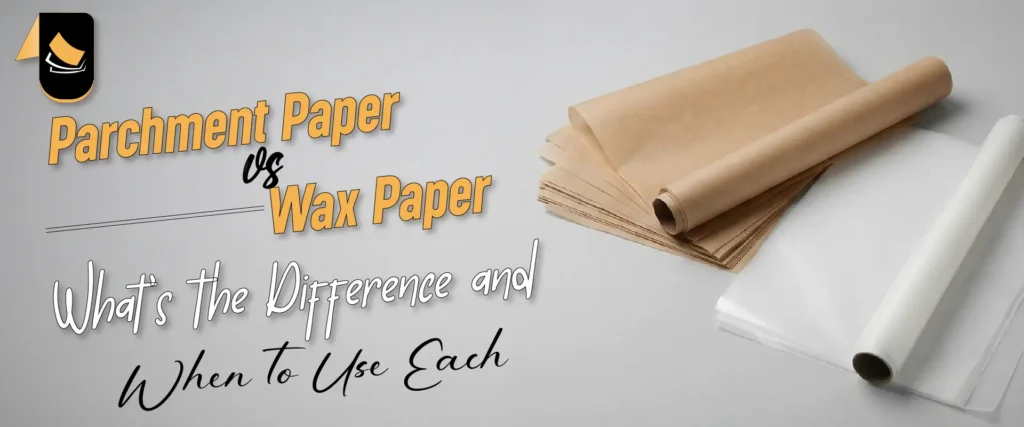
Parchment is a white or brown paper sheet that is silicone-coated and feels waxy. Water droplets bead on it, and it does not crack when crumpled. Parchment is highly resistant to heat and can be used in an oven at 420 to 450°F. If you hold the paper to the light, it looks uniformly translucent. The core differences between parchment and other papers are as follows:
| Product Profile | Base Material | Thermal Limit | Barrier Strength | Best Application |
| Silicone Parchment | Treated pulp | High heat | Grease proof | Oven baking |
| Paraffin Wax | Coated paper | Low melting | Moisture block | Cold wrapping |
| Grease proof | Dense fiber | Moderate heat | High resistance | Fry liners |
| Deli Wrap | Wax coated | Low heat | Fair barrier | Sandwich packaging |
| Kraft Sheet | Unbleached pulp | Moderate heat | Low moisture | Grocery bags |
| Butcher Stock | Heavy paper | Low heat | Good resistance | Meat wrapping |
| Freezer Wrap | Plastic lined | Low heat | Total block | Cold storage |
Manufacturing Process
The manufacturing process of the paper consists of controlled chemistry. This is to ensure that customers get accurate functionality of custom parchment wrapping paper. From the selection of raw material to the application of silicone coating, everything is done in coherence for a premium quality sheet. The following processes are involved in manufacturing.
Raw Material Selection
Softwood and hardwood fibers are used to manufacture parchment. Long fibers give strength to the paper, while short fibers give smoothness. We are sure that the pulp is free from contamination, as impurities can give pinholes and weak spots in the paper. It can also lead to migration of grease and moisture in the paper that can reduce the overall quality.
Pulping And Bleaching
The next step in the manufacturing of custom printed parchment paper is pulping and bleaching, where wood chips are cooked via the Kraft process. Here, the lignin is dissolved to release cellulose fibers. The resulting pulp is washed and bleached to whiten it. We use elemental chlorine or totally chlorine-free bleaching agents to brighten the paper. If brands need unbleached paper, then the bleaching is skipped.
Stock Preparation And Refining
Paper pulp is slushed in water and refined between rotating disks. The refining process fibrillates the fibers so they can bond tightly and create a dense, low-porosity sheet. Filler must be avoided to maintain the smoothness of paper. With the help of wet strength or sizing additives can be used to enhance the smoothness, but they must be FDA-approved.
Sheet Forming
In the manufacturing process of printed parchment paper for baking, the refined stock is pumped into the moving wire mesh. This wire mesh is also known as a Fourdrinier machine, where it is drained, and a continuous web of paper is manufactured. The GSM of the paper is controlled via: which ranges from 30 to 50 g/m 2.
- Machine speed
- Headbox flow
- Vacuum boxes
These steps are carefully managed to ensure uniform paper manufacturing.
Pressing And Drying The Base Paper
In this step, the wet web is passed through paper rolls that squeeze out water over steam-heated dry cylinders. Controlled drying of the paper prevents curls and cockling in the sheets. At the end of this process, we get an unparchmentized paper with a moisture content of 5 to 7 percent. These resulting paper sheets are wound around large rolls or reels for the next step of manufacturing.
Parchmentizing Or Acid Treatment
65 to 75 concentration of sulphuric acid is used to bathe the sheets. The acid swells and partially gelatinizes the cellulose surface and seals the pores. This creates a durable and grease-resistant fiber with a water-storing structure that defines a high-quality printed parchment paper for food.
Washing And Neutralizing
After the acid bath, the paper is washed with water to stop the reaction. After this, alkali is used to neutralize the paper. Multiple rinsings are ensured to remove the residual acid and salts. We make sure that the water is recycled under EPA water regulations to prevent water wastage.
Softening And Drying
The neutralized paper sheet is treated with glycerine or other plasticizer to keep the paper flexible. After this, the air is heated on a heated cylinder to lock in smoothness and dimensional stability. At the end of this stage, a translucent and dense sheet of paper is achieved.
Silicone Coating
This is one of the critical steps in the manufacturing of custom parchment paper sheets, where a thin layer of silicone is applied to the paper. Usually, platinum- or tin-catalyzed polydimethylsiloxane is coated on the paper by roll or gravure coating. Coating weight is carefully controlled for consistent release, and I kept it around 0.5 to 1.5 g/m 2.
Curing
High-temperature ovens are used to cross-link the silicone into a durable and non-migrating film. Proper curing is essential to prevent it from transferring to food and to keep its release properties intact. We use a rub test for quality control of silicone coating.
Printing On Parchment
For parchment paper with logo, we use flexography printing methods that require water-based inks. These inks need a surface energy of 36 dynes/cm to adequately bond with the paper. When untreated paper is used, the surface energy is 22–28 dynes. This is below the wettability threshold for ink adhesion. We use the corona discharge treatment to ionize the parchment paper surface at 10 to 50 kV. This process generates free radicals that oxidize the silicone and cellulose surface, and three groups are generated:
- Carbonyl
- Hydroxyl
- Carboxyl
These functional groups are polar and generate surface energy to enhance the wettability window within which food-safe inks adhere and penetrate. Businesses that need parchment or deli paper sheets with high branding and easy release can confidently buy from us. This is because our food papers have fade-resistant printed designs that provide continuous branding. We have multiple printing options based on the following:
Flexographic Printing
This is one of the common methods that are used in the printing of parchment sheets. Flexography plates transfer fast-drying, water-based ink onto the paper. This is an excellent method for bright colors at low cost for large volumes. Silicone-coated surfaces need special treatments. That is why printing is done before coating on the uncoated side.
Gravure Printing
In this printing process, engraved cylinders are used to deposit inks with excellent detail and solid color. This process suits high-quality and photographic images. The setup cost of gravure printing is high. That is why it is best for major brands with stable networks and large budgets. Gravure printing is perfect for smooth surface printing like custom parchment paper rolls.
Digital Printing
Digital inkjet printing needs no plates, enabling short runs, variable data, and fast design changes. It suits small bakeries and custom orders. Silicone surfaces limit ink adhesion, so printing is usually on the uncoated side or on specially treated sheets.
When variable data and fast design changes are required, digital printing is selected. Digital printing suits small and custom orders. As the silicone-coated surface limits ink adhesion, printing is done before coating.
Screen Printing
This is a slower process than flexo and gravure printing, but is used when premium and promotional parchment products are required. Screen printing pushes inks through a mesh stencil and gives opaque designs.
Offset Lithography
It is a less common method for printing paper sheets, as it is less efficient for non-porous surfaces. Parchment paper printing needs fast-drying inks and quick settings. That is why offset is rarely used for printing parchment.
In addition to the use of different printing processes, we use multiple inks to design the paper. Brands are allowed to choose what suits their packaging requirements and their pricing budgets.
Water-Based Inks
This is an industry standard for parchment that is low in VOCs and easy to clean. Water-based inks comply with food-grade packaging standards and are commonly used on food papers. There are several features that make it a gold standard in printing, such as:
- Dry fast on flexo lines
- Give good color strength
- Support sustainability claims
- Its heat resistance depends on the formulation.
Food-Safe and Low-Migration Inks
These inks are designed to minimize the transfer of components into food. They are essential when printed surfaces might contact food or when parchment is heated. Suppliers provide compliance documentation aligned with FDA rules. Brands use them on the outside surface of wraps and liners.
Soy- And Vegetable-Based Inks
These inks are made with vegetable oils and have low VOCs that grab the attention of climate-conscious individuals. You can use them on bleached and unbleached parchment that is easy to compost. However, the heat resistance depends heavily on formulations.
UV-Curable Low-Migration Inks
Ultraviolet lamps are used to cure UV inks instantly. These inks give sharp colors and have excellent abrasion resistance. For food packaging, brands use low-migration inks with no solvent to evaporate. UV inks work well for non-absorbent surfaces but are costly. That is why they are mainly used for parchment sheets that are used as basket liners in high-end restaurants.
Size Options
In the UK, the sizes of parchment wrapping paper range from 12 to 15 inches in width for household uses. For commercial applications, half sheets and full sheet pans are used. Accurate sizing is essential to avoid overhang and waste. Excessive paper can also catch fire in the oven. We give our customers multiple sizes so that they can select based on their needs. The common sizes are as follows:
| Format | Typical size | Common use |
| Household roll | 12″ x 25 to 75 ft | Home baking |
| Household roll (wide) | 15″ x 45 to 164 ft | Home and cafes |
| Quarter sheet | 9″ x 13″ | Small pans, toaster ovens |
| Half sheet | 12″ x 16″ or 13″ x 18″ | Standard commercial pan |
| Full sheet | 16 3/8″ x 24 3/8″ | Full bakery pan (18″ x 26″) |
| Foodservice sheet | 16″ x 24″ | Bakeries, restaurants |
| Cake rounds | 6″, 8″, 9″, 10″ diameter | Cake pans |
| Bulk foodservice roll | 24″ to 30″ wide | Industrial lines |
| Cupcake/muffin liners | 2″ to 3.5″ | Cupcakes, muffins |
In addition to the dimensions th we have mentioned in the table above, you can get parchment paper sheets for the following sizes and styles:
- Pre-cut sheets
- Cake round cutouts
- Pan liners with a fold-and-crease design
- Perforated rolls
- Dispenser boxes with slide cutters
- Interleaved foodservice sheets
- Grease-resistant wrappers and pouches
- Unbleached and compostable variants
- Reusable-grade heavy-weight sheets
- Air fryer liners
Why Choose Us?
At our company, we make sure that our customers get high-quality paper that fully complies with the rules set by regulatory authorities. As a parchment paper wholesale provider, we offer low rates and free shipping to all customers. Our company follows the standards mentioned below to manufacture the paper. Such as:
FDA compliance
We use food-contact raw materials that must comply with 21 CFR 176.170 and 176.180 for paper components. For resinous coating, 21 CFR 175.300 is followed. We know that an FDA complaint is a legal complaint and not a formal certificate. Therefore, we ensure full compliance.
FSC (Forest Stewardship Council)
We ensure that the wood pulp comes from sustainably managed forests. That is why we use the FSC chain of custody certificate. Our facility is audited and is authorized to use the FSC logo on the packaging. We know that this is voluntary, but essential for climate safety.
BPI (Biodegradable Products Institute)
Under ASTM D6400, our commercial facility has the option of compostable paper. Some unbleached options have BPI certification, but not all. Our raw material is lab-tested for disintegration and heavy metals. This option is slightly expensive and is provided upon customer demand.
BRCGS Packaging Materials
This is a global food safety standard that covers hygiene and hazard analysis. BRCGS also allows traceability and quality management for packaging manufacturers. Our company uses it in the UK to prevent contamination risks.
ISO 9001 and ISO 14001
In this certification, we ensure that manufacturing is done under environmental safety standards. It does not require food specificity but is essential for environmental safety. Our company controls wastewater and emissions by following the standards below:
- ISO 9001 certifies a consistent quality management system
- ISO 14001 certifies environmental management.
Kosher and PFAS-free declarations
With the use of Kosher certification, we ensure the absence of non-Kosher additives. A PFAS declaration is vital in certain states such as California and New York. Even Washington also restricts PFAS use. The three common Kosher certifications must be considered:
- OU
- OK
- Star-K
Note: Certain regulatory standards are not 100 percent complied with, resulting in high costs. However, brands can request them, and we will accommodate them accordingly.
Add-On Option For Parchment
Although food wrapping paper does not have many add-on options. Nonetheless, we offer certain options that enhance the premium look. Baking parchment sheets are rarely designed with add-ons. For presenting food in a high-end setting, we offer foil stamping and textured designs. Brands can select the logos and other small artwork in the corners of the paper with these specifications.
Select Our Packaging Services!
Brands that are looking for food-safe and high-quality parchment paper for hair products can select the custom paper manufacturing services of Custom Grease Papers. We have one of the finest manufacturing facilities that deliver the order in just a couple of days. You just have to let us know what your specifications are, and our team will abide by your choices with full customer support.
Dimensions
| 4" × 4" | 5" × 5" | 6" × 5" | 6" × 6" |
| 7" × 5" | 7" × 7" | 8" × 5" | 8" × 6" |
| 8" × 8" | 8.5" × 11" | 9" × 5" | 9" × 6" |
| 9" × 9" | 10" × 5" | 10" × 6" | 10" × 8" |
| 10" × 10" | 10.75" × 10" | 12" × 6" | 12" × 8" |
| 12" × 9" | 12" × 10" | 12" × 12" | 13" × 6" |
| 13" × 9" | 13" × 10" | 13" × 13" | 14" × 12" |
| 15" × 9" | 15" × 10.75" | 15" × 12" | 15" × 13" |
| 16" × 12" | 17" × 11" | 18" × 10" | 18" × 12" |
| 18" × 13" | 20" × 10" | 20" × 12" | 20" × 13" |
| 20" × 15" | 20" × 18" | 20" × 20" | 20" × 25" |
| 20" × 28" |
| Type | Specifications |
|---|---|
| Dimensions | All Custom Sizes & Shapes Available |
| Quantities | No Minimum Order Required |
| Material | Premium Rigid Chipboard (36pt to 120pt), Greyboard, Paper Over Board Construction |
| Printing | No Printing, CMYK, CMYK + 1 PMS Color, CMYK + 2 PMS Colors, Full PMS Printing |
| Finishing | Gloss Lamination, Matte Lamination, Soft-Touch Lamination, Spot UV, Embossing, Debossing, Foiling |
| Included Options | Die Cutting, Magnetic Closure, Ribbon Pull, Custom Inserts, Window Cut-Out |
| Additional Options | Eco-Friendly Materials, Recyclable Rigid Boxes, Velvet Lining, Satin Lining |
| Proof | Flat View, 3D Mock-up, Physical Sampling (On Request) |
| Turnaround | 8 - 12 Business Days, RUSH Available |
| Shipping | Flat Shipping Rate |
| Box Styles | Magnetic Closure Boxes, Two-Piece Rigid Boxes, Drawer Boxes, Book Style Boxes, Shoulder Neck Boxes |
| Insert Options | Foam Inserts, EVA Inserts, Cardboard Inserts, Velvet Inserts, Molded Pulp Inserts |
| Applications | Luxury Product Packaging, Jewelry Boxes, Electronics Packaging, Gift Boxes, Cosmetic Packaging |
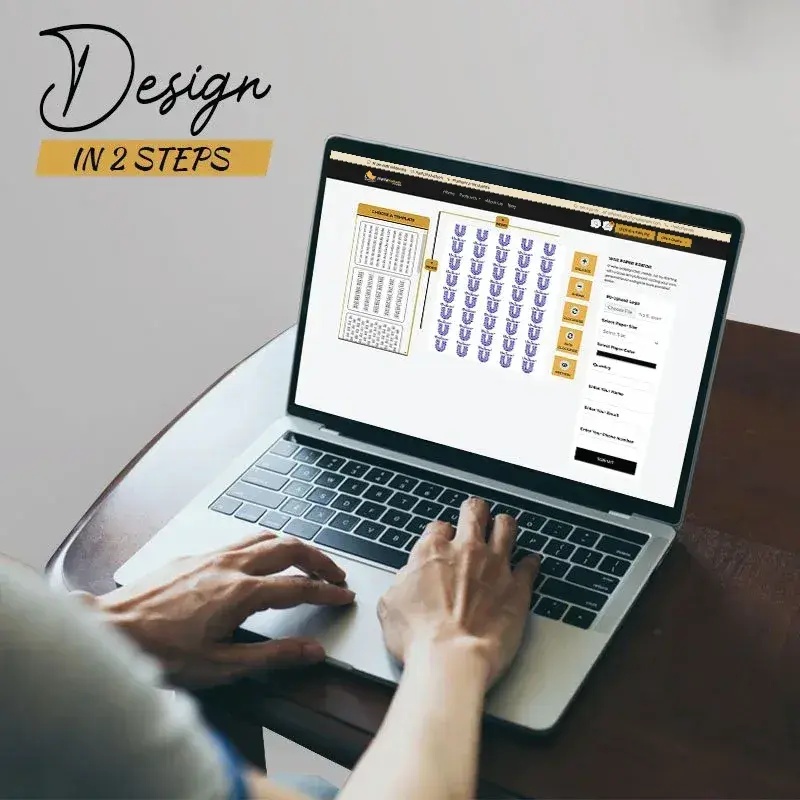
Design Online Your Custom Greaseproof Papers Online
Introducing our Custom Paper Designs. A one-of-a-kind tool to create stunning and personalized greaseproof papers. Fill in the specifications and design without any technical experience.
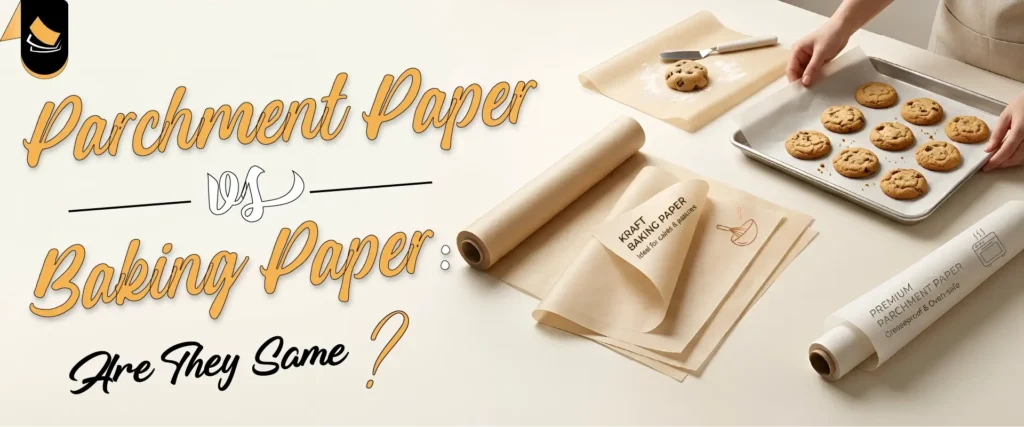
Yes! These two are the same type of paper. Both names are used interchangeably.
The white one is bleached for high-quality painting. The brown paper is unbleached and gives a raw look.
You can use both sides, as the coating is applied evenly on both sides.
You can use the paper in high-heat applications, but avoid using it under the oven broiler and as an alternative to freezer paper.
Yes! The paper is safe for toaster and microwave applications.
You can use aluminium foil for baking, but parchment paper is a better option. This is because parchment limits bottom over-browning and chemical leaching.
Yes! This is the best thing for pan-searing delicate fish or sticky food. You can also ensure calorie control due to the reduced oil requirement.
You can place the dough between the two sheets and roll it flat without using flour. This process keeps a perfect balance of moisture and dry ingredients.
Yes! You can reuse the paper around 3 to 4 times. But this is possible only when you have done low-grease baking, like consecutive cookie batches.
For this, you have to take a square piece of paper and fold it into a triangle. Now you can measure from the center of your pan and trim the outer edge in a curve to get the right fit.
Custom Grease Paper: Your Trusted Paper Supplier
See why restaurants and food businesses rely on our custom greaseproof paper for consistent quality.
Read Our Latest Blogs
A few minutes read to help you understand your product requirements better and to build a premium brand.