
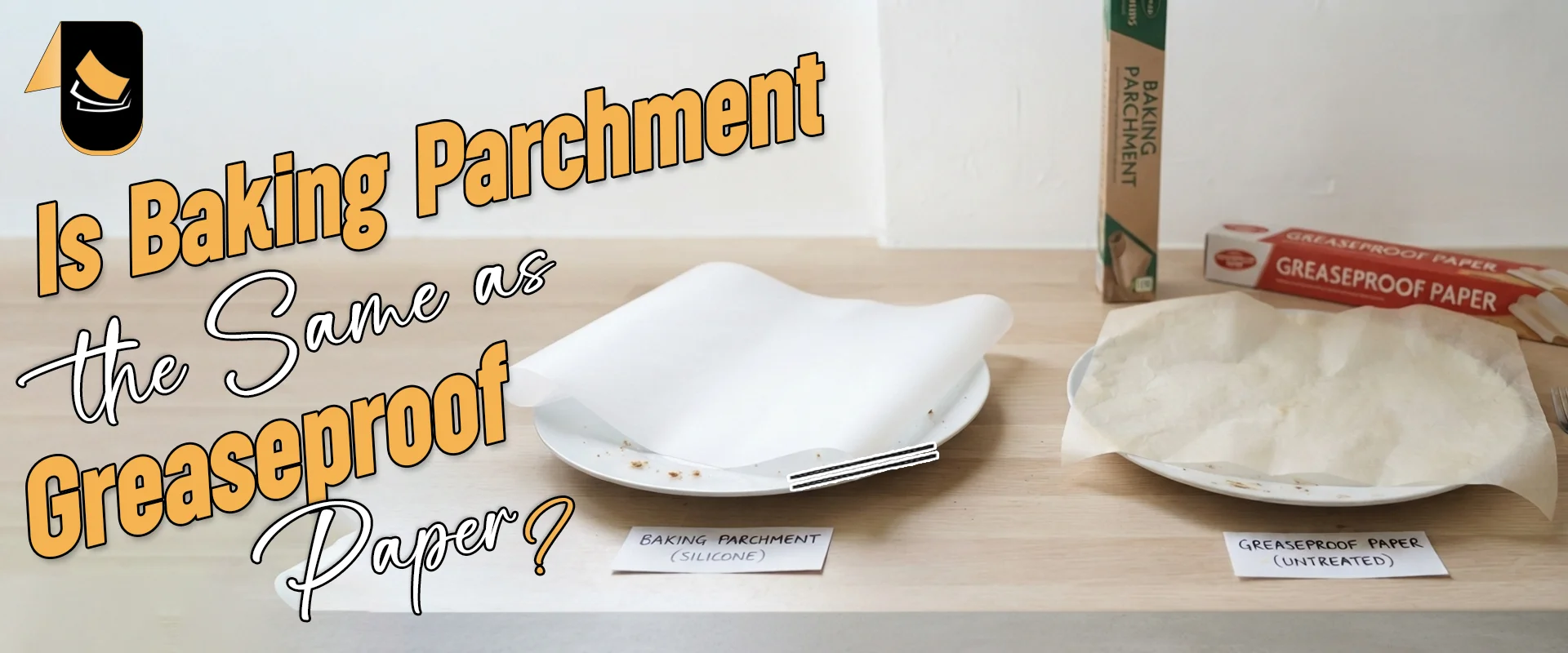
Is Baking Parchment the Same as Greaseproof Paper?
People running a food-related business or home-based bakery lines widely use greaseproof paper for wrapping or cooking food and baking cookies. They often assume that greaseproof and parchment paper are the same, as they both look the same and can resist fats and oils. But they are wrong and often end up with a baking fail by using greaseproof paper for baking instead of parchment paper. Both papers have different uses and chemical processing. They are multipurpose, but cannot be used interchangeably.
These papers are customizable in terms of their thickness and grammage. The following is a detailed analysis of parchment and greaseproof paper so you can understand their core differences and don’t end up with a baking or cooking disaster.
What Is Baking Parchment Paper?
In the UK, baking parchment and parchment paper are the same terms for speciality paper used for baking. It is a standard and ideal choice for commercial bakeries. They have a strong molecular structure with silicone-oxygen atoms that can endure high temperatures in the oven. Baking papers are multipurpose and are used locally and commercially in bakeries and household kitchens.
What Is Greaseproof Paper?
Greaseproof paper is a food-grade paper popular for its grease- and moisture-resistant qualities. It has tightly packed wood or plant fibres that prevent oil or grease from seeping and leaking. It is used by cafes or restaurants for wrapping sandwiches and other fast food items.
Composition Of Greaseproof And Parchment Paper
Base Material
- Greaseproof paper is composed of wood pulp, usually kraft or bamboo blends, that is naturally brown and later bleached to give a white and smooth surface. The cellulose fibres are tightly bonded together.
- Parchment paper is derived from waterleaf or standard kraft paper pulp that is responsibly sourced for environmental reasons.
GSM
- Greaseproof paper: 30 GSM to 70 GSM
- Parchment paper: 35 GSM to 60 GSM
Coating
- The standard Greaseproof paper is uncoated, but some manufacturers add wax or mild barrier layers on demand or for customisation.
- Parchment paper is coated with silicone on both sides to create a non-sticky surface. It is food-safe and does not melt or burn at high temperatures.
Heat Resistance Ability: Greaseproof vs. Parchment Paper
Greaseproof paper has poor heat retention as compared to baking paper. However, it can still work best for wrapping hot sandwiches or paninis or for use in the microwave. It can handle temperatures between 180 and 200 ℃ (356 to 392 ℉ ). In comparison, baking paper has high heat resistance, and it can be used for baking in the oven and cooking en papillote. Parchment paper is manufactured and coated to endure temperatures up to 230°C (450°F ).
Functions And Features Of Parchment Paper
Parchment paper is versatile and can be used in several ways in the kitchen. Other than baking, it has many characteristics and uses:
- Transfer Cookies effortlessly
- Use for baking tray liners or moulds
- It has very low porosity
- Useful for roasting and steaming due to its breathability
- Silicone coating makes its surface shiny
- High strength and durable structure
- Heat- and moisture-resistant surface
- Doesn’t require physical oil and butter on paper before baking
- Tear-proof and non-sticky texture
- Use for rolling cookie and pastry dough
- DIY piping bag for icing or frosting
Functions And Features Of Greaseproof Paper
Greaseproof paper is multipurpose and can be used in many other ways in cafes and households. It has various features and uses as follows:
- Used for lining baking trays and pans
- Used for serving trays in cafes and restaurants
- Absorbs moisture and heavy grease from foods
- It has a matte surface
- Breathable structure prevents food from getting soggy
- Ideal for packaging food for takeaway and delivery
- Safe for microwave use
- Keeps food crisp and fresh
- Surface can be used for printing and other custom designs
- Used for wrapping food hygienically and professionally
Cost Analysis
If we analyse the cost of both papers, we will conclude that parchment paper is higher in cost as compared to greaseproof paper. The reason is the additional mechanical process and surface treatment at the manufacturing end. Parchment paper requires silicone coating on both sides, gelatinising and acid bath treatments for that ‘true’ and ‘traditional’ parchment appearance and performance.
Can They Be Used Alternatively?
This question has no simple ‘yes’ or ‘no’ answer. They can be used alternatively, but it entirely depends on their application. Baking paper can be used instead of greaseproof paper for wrapping or packaging cold or hot sandwiches, other deli subs or even bakery items. But greaseproof paper can not be used in the oven for baking in place of parchment paper unless it is greased manually with oil or butter. And the reason is that sugar or sticky food might stick or cause tears.
Which One Should You Choose?
Choose parchment paper:
- If you are a commercial bakery that produces bakery goods on a large scale.
- If you are well equipped financially.
- If you want to contribute to a healthy environment and have sustainable business goals.
- If you want non-stick properties and high heat resistance.
- If you want your cookies and pastries to be baked perfectly and have a uniform texture and taste.
Choose greaseproof paper:
- If you are a home-based bakery or a small business.
- If you are baking at a moderate temperature or a temperature lower than 180 ℃.
- If you are using grease or oil physically for baking liners, so that sugary food doesn’t stick.
- If you want to wrap foods or line serving trays.
- If you are packaging sandwiches or burgers for takeaway or deliveries.
- If you prefer grease and moisture resistance.
- If you want to keep your packaged food warm and fresh for a long period.
- If you have a restricted budget for your business.
Conclusion
Both papers are distinct in their nature and properties, yet so similar. One is ideal for baking, and the other is for packaging. If you want mess-free or grease-proof food packaging, or if you want cookies that do not stick and release efficiently from baking trays, then you must understand the function and properties of greaseproof and baking paper extensively. They can be used alternatively, but one must keep in mind their surface treatments and heat resistance capabilities. If you have a sustainable business goal, you can opt for any of the given papers.
Contact us!
If you have further queries, we are just a call away. Contact us now for customer support or any kind of assistance. Fill out a quick quote or place your order now at Custom Greaseproof Paper for the best quality products.